

Market Study · October 2026
Market Perspectives – October 2026
Credit beyond the Headlines
This newsletter explores the broader macro and portfolio context and why credit can still add value in an environment of high interest rates and tight credit spreads.
For institutional and professional investors only.
Welcome to the second edition of 59 Capital Partners Market Perspectives
At 59 Capital Partners, we aim to contribute to the investment dialogue around the questions, risks and opportunities shaping institutional portfolios. The objective is to combine broader macroeconomic and portfolio perspectives with specialist expertise from across our network.
Download PDF versionThis month's perspective
This newsletter explores the broader macro and portfolio context and why credit can still add value in an environment of high interest rates and tight credit spreads.
The macroeconomic backdrop remains relatively supportive, with solid growth and strong corporate earnings, while inflation risks continue to keep interest rates elevated. This creates an unusual environment for investors: government bonds once again offer meaningful yields, while credit spreads provide relatively limited additional compensation for risk. Against this backdrop, the case for credit is less about further spread compression and more about carry, credit quality and careful selection.
Why credit?
Higher interest rates have once again made credit markets an attractive source of income. Solid growth, strong corporate earnings and functioning funding markets support companies' ability to service debt. Credit spreads remain tight by historical standards, limiting the scope for further valuation gains. Returns therefore do not need to rely on falling rates or tighter spreads. Carry and, in some parts of the market, roll-down can still generate attractive returns as long as credit quality holds.
Why this matters to us
At 59 Capital Partners, we look for strategies where the sources of return and risk can be clearly understood and where specialist expertise can add value. When credit spreads are tight, analysis of companies’ cash flows, leverage and refinancing capacity becomes particularly important. Through collaborations with specialist credit managers, including ALTAAL and Golding Capital Partners, we look forward to discussing the analysis and how different credit strategies can contribute to returns and diversification in a broader institutional portfolio.
Partner Perspective – Golding Capital Partners
“We continue to see attractive opportunities across European private markets. Europe combines innovative mid-market businesses, attractive valuations and several long-term growth drivers. In private credit, these characteristics are complemented by attractive opportunities in the lower mid-market, where disciplined underwriting and strong lender protections remain key differentiators.”
We hope you enjoy the perspective and invite you to contact us if you would like to discuss the analysis or the role of different credit strategies in a broader portfolio.
Contact
Tina Söderlund-Boley
Founding Partner
Johan Wahlman
Founding Partner
Bul Ekici
Senior Economist
Macro & Markets
Global inflation risks remain elevated due to supply disruptions, particularly those linked to developments in the Middle East. Cost pressures have broadened and intensified further, reflected in higher prices for refined petroleum products and European gas. Higher energy and transport costs also risk feeding more broadly into companies' pricing. A strengthening El Niño is increasing the risk of disruptions to food production. The longer these disruptions persist, the greater the risk that cost pressures become more persistent through wage setting and inflation expectations. Demand-related factors, not least strong AI-related investment activity in the US and parts of Asia, are also helping to keep inflation pressure elevated.
The global growth outlook remains solid, despite uncertainty and disruptions related to trade policy, tariffs and geopolitical conflicts. AI-related investment and production are supporting activity, particularly in the US, while defence and infrastructure spending are contributing in Europe. Fiscal support measures in several countries are cushioning the impact of higher energy and food prices on household purchasing power, while also sustaining demand. The latest PMI readings point to continued expansion in several major economies. However, if supply disruptions persist and require more forceful monetary tightening, the growth outlook could weaken.
Monetary policy expectations have shifted in a more hawkish direction. Several G10 central banks have raised rates this year and we expect further gradual tightening. Long-term government bond yields have also risen to multi-year highs, reflecting inflation risks, tighter policy and large public and private financing needs (see Graph 1). We therefore remain cautious on long duration.
Higher market rates have so far passed through unevenly to corporate funding costs. Credit spreads remain tight and access to market financing is generally good. Many larger companies locked in long-term fixed-rate funding during the low-rate period, while strong earnings and cash flows make higher costs manageable (see Graph 2). For companies with weaker earnings and cash flows, floating-rate debt or larger refinancing needs, however, the higher-rate environment is more challenging.
Strong earnings prospects have supported resilience in equity markets, although concentration remains particularly high in the US. Higher long-term yields have periodically weighed on prices and weakened portfolio diversification when equities and bonds have fallen together. Although higher rates have not triggered a major reallocation away from equities, they limit the scope for further multiple expansion.
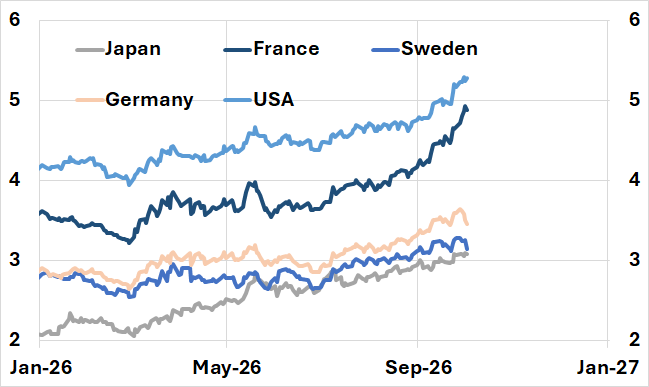
Note: 10-year government yields, per cent.
Sources: Investing.com, 59 Capital Partners.
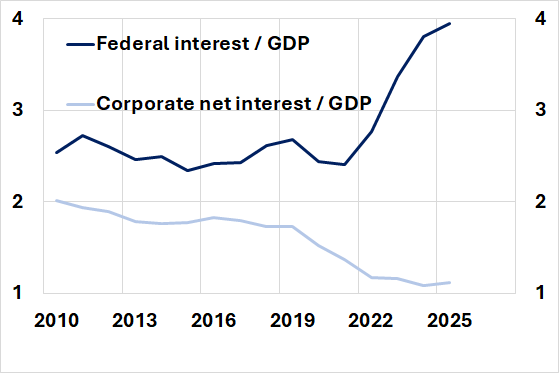
Note: Annual data, per cent of nominal GDP.
Sources: BEA, 59 Capital Partners.
Our main scenarios
Base: solid growth and manageable inflation
Growth and earnings remain supportive of risk assets. Inflation risks require some additional monetary tightening, but broader price pressures remain contained.
Alternative: upside inflation risk
Inflation proves more persistent and monetary policy tightens more than expected. Growth remains resilient, but higher yields weigh on valuations and refinancing costs.
Alternative: stagflation
Prolonged supply disruptions weaken growth while keeping inflation elevated. Monetary policy remains restrictive and earnings deteriorate, creating a more challenging environment for risk assets.
Portfolio perspective
Portfolio diversification remains challenging amid inflation and supply shocks. Higher rates have restored income to fixed income, while solid growth continues to support equities. Credit can add income, but risks differ across the quality spectrum: investment grade carries more duration risk, while lower-quality credit is more exposed to growth and refinancing. With spreads tight, selectivity matters. Returns are likely to come mainly from carry rather than further spread compression. This month's deep dive looks at where credit can still add value and what investors should monitor.
Deep Dive: Credit – attractive carry, limited room for error
Higher rates have changed the outlook for fixed-income investing. After years of low income, credit markets again offer yields where a larger share of returns can come from carry rather than capital gains. At the same time, despite some recent widening, credit spreads remain tight by historical standards. Tight spreads can reflect strong credit quality, but also limited compensation for credit risk. As Factbox A shows, movements in the government benchmark can also affect the measured spread even if corporate credit risk changes little. All-in yields are therefore attractive, while the additional compensation for credit risk is limited.
Factbox A: Why tight spreads can coexist with high yields
Corporate yield ≈ government bond yield + credit spread
Government bond yield ≈ expected policy rates + term premium
Term premium: compensation for holding longer-term government bonds, reflecting inflation uncertainty, bond supply and demand for duration.
Credit spread: the compensation investors require for taking corporate credit risk.
Credit spreads are historically tight, but this can partly be justified by corporate fundamentals. The global economy has been resilient, companies' earnings capacity is solid and many larger companies have strong balance sheets and long-term funding locked in at relatively low rates. Some highly rated companies even carry higher credit ratings than their home sovereigns. Companies can also adjust their financing through refinancing, maturity management and access to multiple funding channels. At the same time, the European banking system is stronger than during the euro-area sovereign debt crisis, reducing the risk that sovereign stress is amplified through bank lending (see Graph 3). Several observers, including the OECD, link the decline in credit spreads in recent years to improved credit quality, better liquidity and strong risk appetite, while government bond yields have been pushed higher by higher term premia and larger funding needs (see Graph 4).
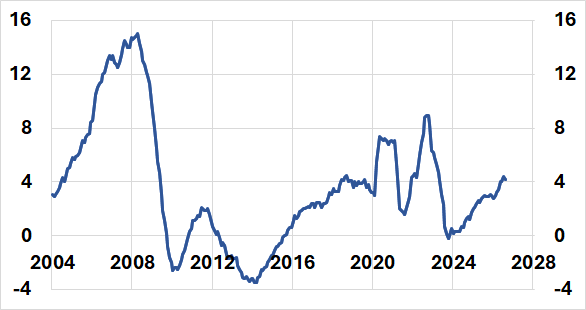
Note: Adjusted loans to euro-area NFCs, annual growth rate, monthly data.
Source: ECB.
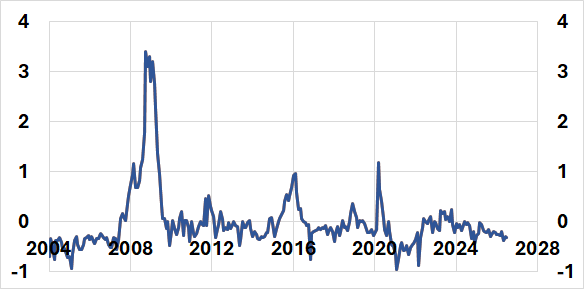
Note: Percentage points, monthly data.
Source: Federal Reserve Board.
Risk, Return & Diversification
Today’s credit market offers an unusual combination of high income and tight credit spreads. Current all-in yields remain attractive: US investment-grade credit yields around 6 per cent, while US and European high yield offer roughly 8 and 6½ per cent, respectively. Yet the credit-spread component is only around 1–3 percentage points, and particularly small in investment grade. In Nordic credit, a high share of floating-rate bonds and shorter maturities can support carry while limiting interest-rate duration, although issuer and refinancing risks remain important. With limited scope for further spread compression, returns are therefore likely to come mainly from carry. Roll-down can also contribute in parts of the market as bonds move closer to maturity.
Factbox B: What should investors monitor?
Defaults
Are problems spreading beyond the weakest borrowers?
Ratings
Are downgrades becoming broader?
Interest coverage
Are funding costs rising faster than cash flows?
Market access
Are bank lending, bond issuance and private credit weakening at the same time?
The diversification that credit adds to a portfolio depends on both credit quality and the underlying macro shock. Investment grade offers higher credit quality but greater duration exposure, while high yield has shorter duration but more sensitivity to growth, risk appetite and refinancing conditions. Falling government bond yields can support investment grade in a traditional downturn, whereas inflation-driven increases in long-term yields can hurt through duration. In a weaker growth environment, high-yield spreads may widen alongside falling equities. The indicators in Factbox B are therefore important for assessing whether stress is beginning to broaden.
Partner Perspective – ALTAAL
“When spreads are generally tight, investors are forced to select credit exposure more carefully. Nordic credit combines floating-rate income, short maturities and strong creditor protection. This can offer investors attractive carry without the duration risk currently weighing on longer-dated bonds. Careful company-by-company selection is key to generating excess returns.”
Portfolio conclusion
Credit can still add value because all-in yields are high and corporate fundamentals remain relatively solid. But tight spreads leave little room for error. The opportunity is therefore less about broad credit exposure and more about choosing where to take risk and selecting borrowers with strong cash flows, manageable leverage and limited refinancing risk. Carry can remain attractive without further spread compression, but credit quality becomes increasingly important as rates stay high.
Disclaimer: For institutional and professional investors only. This material is provided for informational purposes only and does not constitute investment advice, a recommendation, or an offer to buy or sell any financial instrument. Past performance is not a reliable indicator of future results. 59 Capital Partners is the brand name of the business introduction services provided by Enabler Partners AB, company registration number 559513-8214. We do not provide any regulated services and are therefore not under the supervision of the Swedish FSA or any other financial regulatory authority.