

Market Study · September 8, 2026
Market Perspectives – September 2026
Catastrophe Bonds and Institutional Portfolios
This Newsletter explores the broader macro and portfolio context and the investment case for catastrophe bonds as the Atlantic hurricane season enters its historically most active period.
Stockholm/London – September 8th, 2026
For institutional and professional investors only.
Welcome to the first 59 Capital Partners Market Perspective
At 59 Capital Partners, we aim to contribute to the investment dialogue around the questions, risks and opportunities shaping institutional portfolios. As part of that ambition, we are launching 59 Capital Partners Market Perspectives together with Bul Ekici. The aim is to combine broader macroeconomic and portfolio perspectives with specialist expertise from across our network.
Download PDF versionThis month's perspective
This Newsletter explores the broader macro and portfolio context and the investment case for catastrophe bonds as the Atlantic hurricane season enters its historically most active period.
The macroeconomic backdrop remains relatively supportive, with solid growth, but inflation risks have not disappeared. The main uncertainties stem from geopolitics, trade tensions and potential supply shocks which continue to pose upside risks to inflation. For investors, this matters because renewed inflation shocks can put pressure on both equities and bonds, making traditional diversification less reliable.
Why CAT bonds?
Against a backdrop of solid growth but still-elevated inflation and supply-shock risks, strategies driven by fundamentally different sources of risk become particularly relevant. Cat bonds have historically shown low correlation with equities and traditional bonds. The timing is also particularly relevant, as the Atlantic hurricane season enters its historically most active period.
Why this matters to us
At 59 Capital Partners, we look for specialist strategies that can fulfil a clear role in institutional portfolios—where the sources of return, the underlying risks and their interaction with the broader portfolio can be clearly understood. Through its collaboration with Plenum Investments, a specialist in insurance-linked securities and catastrophe bonds, 59 Capital Partners would be pleased to discuss the analysis and the potential role of cat bonds in a broader institutional portfolio.
In collaboration with Plenum Investments
This edition of Market Perspectives is in collaboration with Plenum Investments, one of 59 Capital Partners investment manager partners. Plenum's specialist market expertise complements broader macroeconomic and portfolio perspective, providing a closer examination of the asset class, its underlying risks and its potential role in institutional portfolios.
We hope you enjoy the perspective and invite you to contact us if you would like to discuss the analysis or the potential role of catastrophe bonds in a broader portfolio.
Contact
Tina Söderlund-Boley
Founding Partner
Johan Wahlman
Founding Partner
Bul Ekici
Senior Economist
Macro & Markets
2026 has so far been an eventful year. Geopolitical tensions surrounding, among other things, Venezuela and Greenland, continued trade conflicts, the war between Ukraine and Russia and developments in the Middle East have contributed to unusually high political and economic uncertainty.
Inflation risks have therefore returned to the radar. Higher energy and transport costs, as well as price increases in other commodities, have increased inflation risks and slowed disinflation in several G10 economies. Price increases remain considerably more limited than during the inflation surge following the pandemic and the outbreak of the war in Ukraine. Without a lasting resolution to the conflict with Iran, inflation risks remain tilted to the upside.
Stable growth figures from particularly Europe and the US have so far been stronger than several indicators suggested earlier in the year. In Sweden, GDP growth in the second quarter was also unexpectedly strong. The latest PMI readings point to continued expansion in both the US and the euro area.
Monetary policy expectations have shifted rapidly in a more hawkish direction as a result of renewed inflation risks and relatively stable growth. Previously priced rate cuts have been scaled back sharply and, in some markets, replaced by expectations of rate increases. Several central banks have already raised policy rates and markets expect further tightening in a number of economies. Most recently, at Jackson Hole, the Fed emphasised the importance of bringing inflation back to target, while the Riksbank sees some probability of a rate increase later this year.
Financial conditions have tightened as government bond yields have risen sharply. The move mainly reflects more hawkish monetary policy expectations, persistent inflation risks, resilient growth and growing fiscal and financing pressures. Long-term yields are now at multi-decade highs in Japan and remain elevated in the US, increasing duration risk across markets, see Graph 1. Credit markets have remained relatively resilient and strong corporate earnings continue to support equities. However, higher long-term yields increase financing costs and raise the discount rate applied to future earnings, creating a growing headwind for equity valuations, particularly in more financing- and duration-sensitive sectors. Energy remains an important upside risk as long as tensions around Iran and the Strait of Hormuz persist, see Graph 2.
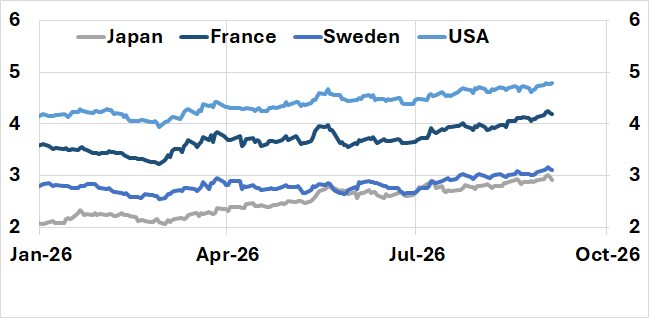
Note: 10-year government yields, per cent.
Sources: Investing.com, 59 Capital Partners.
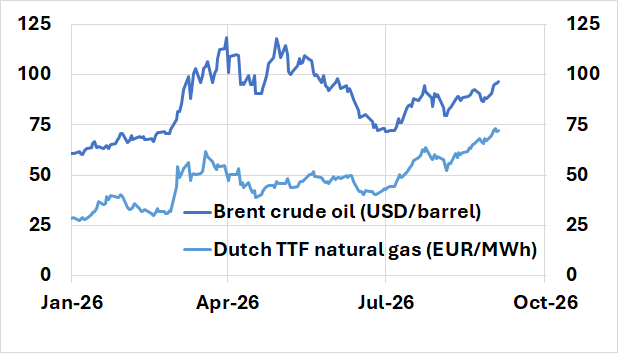
Sources: Investing.com, 59 Capital Partners.
Our main scenarios
Base: solid growth and manageable inflation
Relatively favourable for risk assets, supported by solid growth and earnings. Inflation risks are elevated and periodically contribute to uncertainty and some monetary policy tightening but are expected to remain manageable.
Alternative: upside inflation risk
Upside risks to inflation dominate, including those related to the Middle East, energy and food prices. This would imply more persistent price pressure and a more restrictive policy backdrop.
Alternative: stagflation
Less favourable for risk assets. The downside is characterized by weaker growth combined with persistently high inflation.
Portfolio perspective
Portfolio diversification remains more challenging in an environment characterized by inflation and supply shocks. At times during August, as earlier in the year, rising long-term yields coincided with falling equity prices, illustrating the need for alternative investments driven by different factors. The focus should be on assets with low correlation to the traditional assets normally held in a portfolio. In this month's deep dive, we therefore look more closely at catastrophe bonds (cat bonds) as a potential source of such diversification.
Deep Dive: CAT Bonds
The summer of 2026 has brought wildfires, extreme temperatures, and severe flooding. At the same time, El Niño is strengthening and is expected to become unusually strong during the autumn and winter. This increases the risk of volatile inflation through disruptions to agriculture, transport, and food prices, reinforcing the type of supply shocks already affecting markets. Conversely, El Niño is expected to suppress activity during the ongoing Atlantic hurricane season, which reaches its statistical peak around 10 September. See Graph 3.
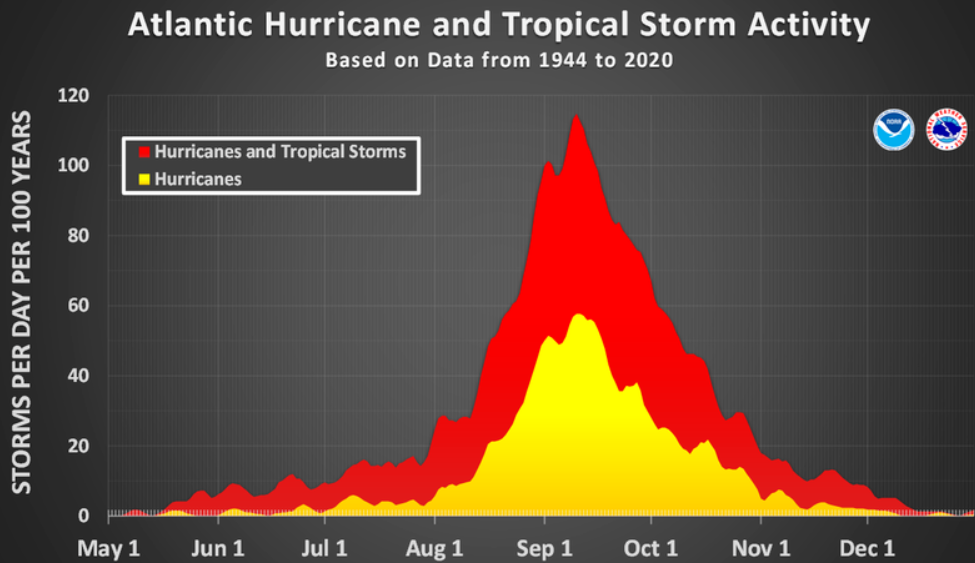
Note: Average seasonal Atlantic hurricane and tropical storm activity, based on data from 1944–2020.
Source: NOAA National Hurricane Center.
How CAT bonds work
1. Investor assumes defined catastrophe risk
2. Receives short-term market rate + risk spread
3. If a defined trigger is met, principal may be used for claims
4. If no trigger is met, principal is repaid at maturity
A large part of the cat bond market is linked to storm risk, particularly US hurricanes. This makes developments during the Atlantic hurricane season especially important. The season has so far been quiet, benefiting catastrophe bonds, or cat bonds, which have outperformed broad government bond indices this year and continue to attract capital. If insured losses remain limited through the end of the season in November, several market observers expect returns to reach double-digit levels this year.
Cat bonds transfer catastrophe risk from the insurance market to investors. Investors thereby assume the risk of specific events such as hurricanes, earthquakes, winter storms, wildfires, or floods. Compensation normally consists of a short-term market rate plus a risk spread that, among other things, reflects expected catastrophe losses. Total returns are also affected by how the market reprices this risk over the life of the bond. If no defined trigger is met, the principal is repaid at maturity. Over the five years to June 2026, the median cat bond fund generated an annual net return of just under 7 percent, according to Morningstar.
Risk, Return & Diversification
The high returns are associated with risk. Investors need to understand how the risk is defined, which events the bond covers, how capital is affected under different scenarios and how actual loss outcomes may differ from model assumptions. Historically, cat bonds have experienced significant drawdowns on a limited number of occasions. The largest decline since 2004 has been around 16 percent, but recovery periods have so far been relatively short, at no more than around nine months. By comparison, global equities took more than four years to recover from the losses associated with the global financial crisis, see Graph 4.
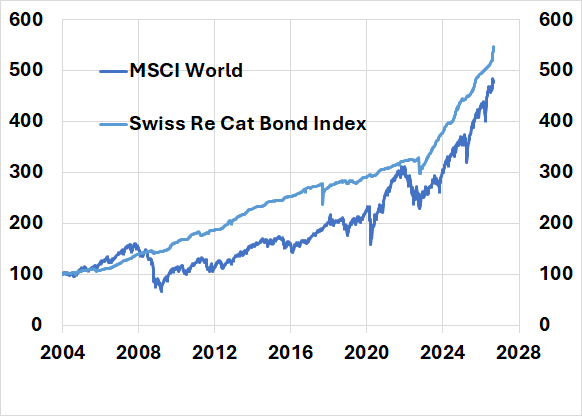
Note: Indexed to 100 at the start of 2004. Weekly data.
Source: Swiss Re, MSCI, 59 Capital Partners.
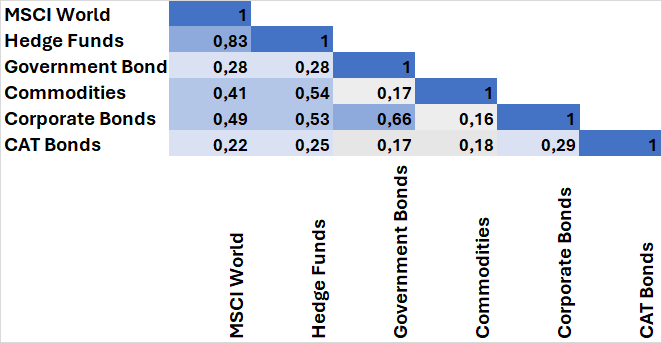
Note: Correlations based on monthly data from January 2002 to June 2026.
Source: Bloomberg, Swiss Re, MSCI, 59 Capital Partners.
The real value lies in diversification. A hurricane in Florida does not occur because the Fed raises interest rates, and an earthquake in Japan does not happen because credit spreads widen. Historically, cat bonds have therefore exhibited low correlation with both equities and traditional bonds, see Table 1. In an environment of recurring weather-related supply shocks, the distinction becomes particularly clear: while traditional nominal bonds are pressured by rising inflation and interest rates, cat bonds are primarily affected by the specific loss event and whether a trigger is met.
Portfolio conclusion
From a portfolio perspective, cat bonds should therefore be viewed as a separate risk premium, rather than as a substitute for bonds. Investors assume model risk, concentration risk and tail risk, but in return gain access to a source of return that follows a different logic from the factors driving interest rates and equities. In a market where upside inflation risks remain present, it is precisely this characteristic that makes the asset class interesting.
Disclaimer: For professional and institutional investors only. This material is provided for informational purposes only and does not constitute investment advice, a recommendation, or an offer to buy or sell any financial instrument. Past performance is not a reliable indicator of future results. 59 Capital Partners is the brand name of the business introduction services provided by Enabler Partners AB, company registration number 559513-8214. We do not provide any regulated services and are therefore not under the supervision of the Swedish FSA or any other financial regulatory authority.