

Market Study · November 2026
Market Perspectives – November 2026
Beyond the Midterms: The Real Test for Markets
This newsletter explores the broader macro and portfolio context and why private credit can add value in an environment of high interest rates and tight credit spreads.
For institutional and professional investors only.
Welcome to the third edition of 59 Capital Partners Market Perspectives
At 59 Capital Partners, we aim to contribute to the investment dialogue around the questions, risks and opportunities shaping institutional portfolios. The objective is to combine broader macroeconomic and portfolio perspectives with specialist expertise from across our network.
Download PDF versionThis month’s perspective
This newsletter explores the broader macro and portfolio context and why private credit can add value in an environment of high interest rates and tight credit spreads.
The global outlook remains relatively supportive, but fiscal risks and market corrections have become more prominent. The real test is whether AI-related investment, alongside other growth drivers, can continue to support growth and corporate earnings despite persistently high financing costs and rising political uncertainty. High yields offer attractive income opportunities, while tight credit spreads increase the importance of credit quality and selection. Against this backdrop, our Deep Dive with Golding Capital Partners explores how market structure, lender protection and information advantages can create opportunities in European lower mid-market private credit.
Why private credit?
Private credit offers long-term investors attractive income potential and greater influence over loan terms. Limited secondary-market trading reduces exposure to short-term market flows but comes at the cost of illiquidity. In the European lower mid-market, less competition and lower borrower leverage can support attractive risk-adjusted returns, while strong lender protections become particularly valuable in a high-rate environment.
Why this matters to us
At 59 Capital Partners, we focus on strategies where specialist expertise can improve the balance between return and risk. In private credit, information advantages, disciplined underwriting and strong loan terms can add value, provided returns adequately compensate for illiquidity and other risks. Through partnerships with specialist managers, including Altaal and Golding Capital Partners, we explore how these strategies can complement public credit in institutional portfolios.
Partner Perspective – Golding Capital Partners
“The European lower mid-market combines less crowded conditions with stronger structures and lower leverage. Better information access and closer borrower relationships support informed, disciplined credit selection”.
We hope you enjoy the perspective and invite you to contact us if you would like to discuss the analysis or the role of different credit strategies in a broader portfolio.
Contact
Tina Söderlund-Boley
Founding Partner
Johan Wahlman
Founding Partner
Bul Ekici
Senior Economist
Macro & Markets
The macroeconomic picture from October remains broadly intact, with relatively solid global growth despite rising downside risks in some economies. Strong AI-related investment activity and public spending continue to support growth. Incoming economic data have generally been slightly stronger than market forecasts (Graph 1). Elevated energy prices, together with other price pressures, continue to pose upside risks to inflation. Meanwhile, several central banks are signalling the need for further gradual monetary tightening, suggesting that interest rates will remain high.
Political factors and fiscal sustainability have, however, become more important drivers of financial markets. The implications of the US midterms and the Democrats’ victory remain difficult to assess. Attention has focused on uncertainty over future foreign and trade policy, while concerns have shifted from inflation and fiscal expansion towards growth risks from reduced political support for AI investment. In Europe, political deadlock in France has hampered fiscal consolidation and driven a sharp rise in risk premia on French government bonds. These concerns have also contributed to higher yields in other euro-area countries and coincided with a weaker euro. A relatively resilient banking sector and stronger institutional safeguards limit the risk of another systemic sovereign debt crisis. Nevertheless, persistently elevated risk premia could spill over to other euro-area countries, gradually raise financing costs and amplify downside risks to growth.
Financial markets have undergone several corrections. Following earlier sharp increases, government bond yields have retreated in several countries (Graph 2). The decline reflects shifting assessments of growth, inflation and risk premia, alongside reallocations from equities into government bonds.
Despite generally strong earnings, equity markets have increasingly questioned AI-related investment needs and future returns, with growing concerns about the implications of a slowdown for the broader economy. The correction was initially concentrated in AI-related stocks but has at times spread to other sectors. Credit spreads have also widened, particularly in riskier segments. Shifts in positioning among leveraged investors, including hedge funds, may have amplified market movements. Uncertainty surrounding growth, inflation and policy suggests that further volatility is likely.
Our main macroeconomic scenarios remain broadly unchanged, but the range of risks has widened. Inflation risks, substantial public and private financing needs and the prospect of further monetary tightening suggest limited scope for a sustained decline in long-term yields. At the same time, recent corrections have improved entry points in parts of the equity and credit markets, while relatively favourable growth prospects and strong corporate earnings continue to support risk assets.
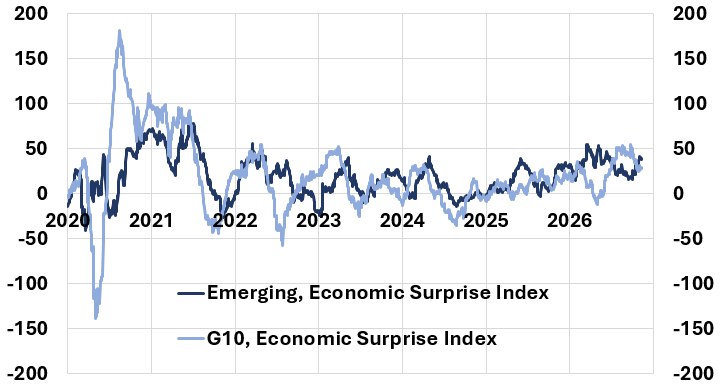
Note: Positive values indicate better-than-expected data.
Sources: Citi, 59 Capital Partners.
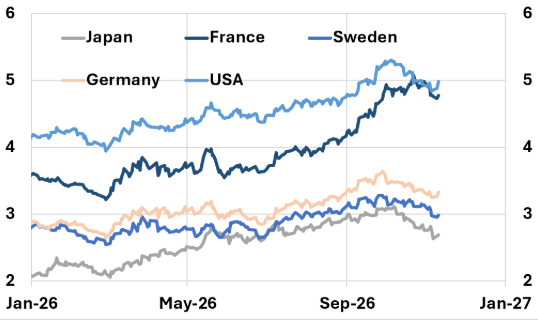
Note: 10-year government yields, per cent.
Sources: Investing.com, 59 Capital Partners.
Our main scenarios
Base: solid growth and manageable inflation
Growth and earnings remain supportive of risk assets. Inflation risks require some additional monetary tightening, but broader price pressures remain contained.
Alternative: upside inflation risk
Inflation proves more persistent and monetary policy tightens more than expected. Growth remains resilient, but higher yields weigh on valuations and refinancing costs.
Alternative: stagflation
Prolonged supply disruptions weaken growth while keeping inflation elevated. Monetary policy remains restrictive and earnings deteriorate, creating a more challenging environment for risk assets.
Portfolio perspective
Our portfolio assessment from October remains broadly unchanged. Recent market corrections have improved some entry points, while attractive bond yields and solid corporate earnings continue to support fixed income and equities. In credit, high all-in yields offer attractive carry, but tight spreads make credit quality and selection increasingly important. This month’s Deep Dive explores how private credit can complement public credit markets through diversification and potentially attractive risk-adjusted returns. Drawing on insights from Golding Capital Partners, we focus on lender protection and the opportunities in European lower mid-market lending.
Deep Dive: Private Credit – Beyond the Headline Yield
Private credit has expanded rapidly over the past two decades, becoming an important part of the global credit market. It consists primarily of directly negotiated loans from non-bank lenders to companies, often privately held. Growth has been driven by companies seeking flexible and tailored financing, expanding private credit platforms and institutional investors attracted by potentially higher yields and diversification opportunities. These benefits must be weighed against limited liquidity, valuation uncertainty and greater reliance on manager expertise.
As more capital has flowed into the market, competition among lenders has intensified, particularly for larger, private equity-sponsored transactions. Many managers have moved towards larger deals, compressing lending margins and weakening lenders’ bargaining power and contractual protections. This can make the risk-return trade-off less attractive for investors.
Why the Lower Mid-Market?
According to Golding Capital Partners, the European lower mid-market’s advantage lies mainly in its market structure. A broader pool of borrowers and less lender competition can strengthen negotiating power and lender protection. Golding’s transaction sample also shows lower leverage than in the core mid-market, potentially increasing resilience to higher financing costs while offering more favourable lending margins and contractual terms (Graph 3).
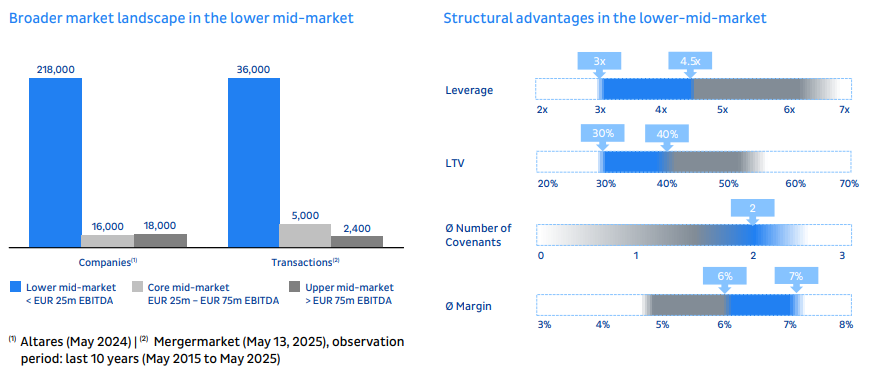
Note: Market-size estimates and selected transaction characteristics. Lending terms are indicative of the underlying sample and not necessarily representative of the entire market.
Source: Golding Perspectives, November 2026.
Closer borrower relationships and better access to operational information can create an information advantage that is harder to achieve in more standardised credit markets. Combined with stronger covenants, this may enable lenders to identify deterioration earlier and negotiate corrective measures at an earlier stage, before problems escalate.
Golding’s historical transaction data also illustrate the advantage. In 2025, the lending margin per unit of leverage stood at 2.1 % in the lower mid-market, compared with 1.2 % in the core mid-market (Graph 4).
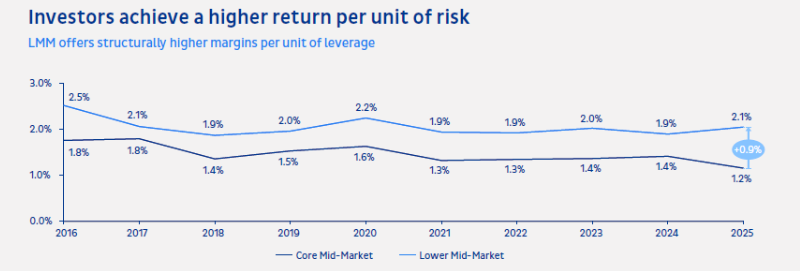
Note: Lending margin divided by borrower leverage. Based on Golding’s analysis of more than 2,300 transactions involving selected lower- and core mid-market managers. The measure does not represent realised risk-adjusted returns.
Source: Golding Perspectives, November 2026.
Risk, Return & Diversification
For institutional investors, these structural advantages are attractive, but the diversification benefits of private credit still depend on borrower quality and the nature of the economic shock. Compared with publicly traded corporate credit, private credit can offer higher lending margins, more tailored terms and greater scope for direct influence over loan structures. Limited secondary-market trading also reduces the direct impact of short-term market flows. However, the potential additional return is not without risk: investors accept lower liquidity, less transparent valuations and greater dependence on the manager’s credit analysis and ability to manage troubled loans.
Portfolio conclusion
High all-in yields and relatively solid corporate fundamentals continue to support credit investments, but tight spreads leave little room for error. Attractive carry increasingly depends on credit quality, manageable leverage and careful borrower selection. Private credit, particularly European lower mid-market lending, can offer attractive carry, potentially combined with lower leverage, stronger lender protections and the benefits of specialist manager selection.
Disclaimer: For institutional and professional investors only. This material is provided for informational purposes only and does not constitute investment advice, a recommendation, or an offer to buy or sell any financial instrument. Past performance is not a reliable indicator of future results. 59 Capital Partners is the brand name of the business introduction services provided by Enabler Partners AB, company registration number 559513-8214. We do not provide any regulated services and are therefore not under the supervision of the Swedish FSA or any other financial regulatory authority.